A managed operations layer beside Clio—not another legal system
A second layer is justified only when the firm has management workflows that cross Clio, finance, intake, email or business-development systems and cannot be controlled cleanly in one place. The useful use cases are firm-specific exceptions such as capacity risk, aging WIP, bespoke referral economics and critical-item assurance.
Research reviewed 2026-09-09. Product and regulatory claims link to primary sources below.
Direct answer
When does a law firm need a CRM layer in addition to Clio?
A second layer is justified only when the firm has management workflows that cross Clio, finance, intake, email or business-development systems and cannot be controlled cleanly in one place. The useful use cases are firm-specific exceptions such as capacity risk, aging WIP, bespoke referral economics and critical-item assurance.
Search topics covered:managed CRM for law firmsClio CRM integrationlegal operations CRM Canadalaw firm CRM Ontariolaw firm WIP workflow
The problem
Where the operating gaps actually are
Legal platforms have matured quickly. Clio, Lawmatics and Filevine already cover much of the basic intake, referral, matter and AI territory, so a credible Vyop page must start by acknowledging that rather than inventing gaps.
Firm-wide management data crosses systems
Matter status, intake, billing, capacity and BD may not produce one management view.
Deadlines need reliable exception control
Calendaring is a legal-system function; management needs visibility into what is at risk or incomplete.
Capacity risk can appear before missed work
Matter load, upcoming deadlines and staffing concentration can create operational risk that is hard to see in a pipeline.
WIP and unbilled work age silently
The valuable workflow is not another billing system—it is early exception detection and owner escalation.
Referral source is not enough
Modern legal CRMs can track referral sources. More advanced firms may need source → matter type → value → realization or relationship-level economics.
Matter-health signals need careful interpretation
Email, deadlines and work status can support triage, but AI should not substitute for legal judgment.
Conflict and intake data must be complete
Missing fields or poorly synchronized client records undermine downstream workflows.
Privilege and confidentiality constrain AI
Access control, model routing and logging need to be designed around the firm's duties.
The managed model
How Vyop would run the layer
The exact automation and integrations depend on the source systems and governance requirements of each client.
Five-way comparison
Vyop vs the alternatives
Vs Clio Manage/Grow, Lawmatics, Filevine
What the vertical incumbent does well: Legal intake, conflicts, matter management, billing, referral/source reporting, workflows and increasingly powerful legal AI. Where Vyop fits: Do not recreate those features. Integrate with Clio or the chosen legal system and focus Twenty on bespoke firm-operations data and cross-system exceptions.
Vs general CRMs
General CRMs are useful for business development, but they are weak substitutes for legal practice management. Twenty is best positioned as a configurable adjacent layer, not the matter system.
Vs self-managed Twenty / in-house CRM
A firm can build the same Clio-to-Twenty architecture itself. Vyop's differentiation must be the maintained mapping, privilege-aware workflow design, recurring data checks and operational support.
Vs other managed CRM services
Salesforce/legal consultants can implement custom workflows. Vyop needs a repeatable Clio-adjacent operating model with defined critical-item audits and management KPIs rather than selling hours of customization.
Directional scorecard
Star comparison by operating requirement
| Option | Vertical workflow fit | Flexibility | Cross-system orchestration | Data integrity operations | Managed ownership | Deployment / data control | Choose it when… |
|---|---|---|---|---|---|---|---|
| Vyop Managed CRM on Twenty | Best when the problem is cross-system, requires a bespoke operating model and needs continuous managed ownership. | ||||||
| Clio Manage/Grow, Lawmatics, Filevine | Best when native vertical depth and system-of-record functionality matter more than bespoke cross-system orchestration. | ||||||
| Salesforce / Dynamics / HubSpot | Best when enterprise breadth, ecosystem and internal CRM capability justify the larger platform. | ||||||
| Self-managed Twenty | Best for organizations with technical ownership that want open customization and can run the operating model themselves. | ||||||
| Other managed CRM services | Best for conventional CRM implementation, administration, migration and RevOps without a deep vertical operating layer. |
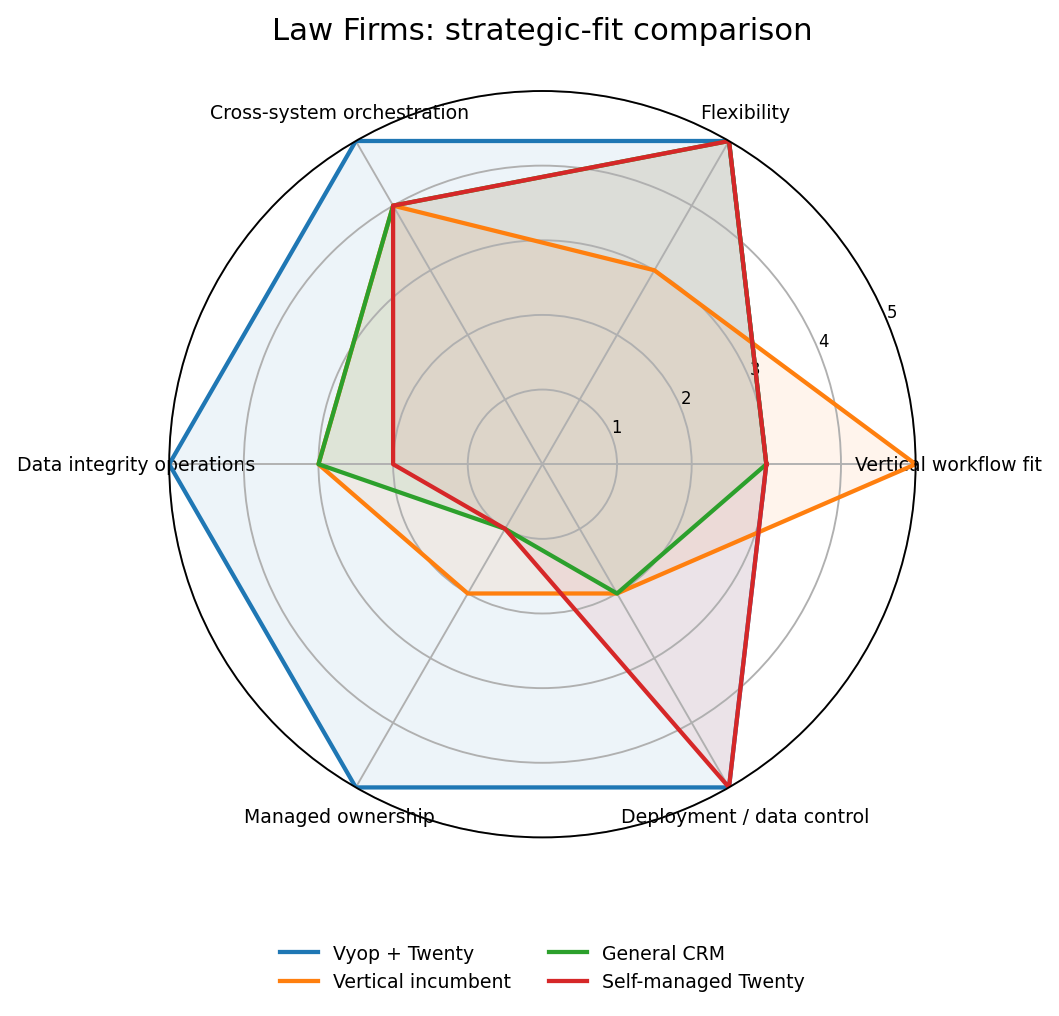
How to read this: 1–5 scores are Vyop's directional strategic-fit assessment based on product scope and the managed-service model—not an independent lab benchmark, uptime test or universal product rating. They are intentionally explicit so buyers can challenge the assumptions.
Spider chart
The shape of the trade-off
The vertical incumbent usually wins on native industry depth. General CRMs win on ecosystem breadth. Self-managed Twenty wins on control. The proposed Vyop model is designed to win where custom orchestration, continuous data integrity and managed operational ownership matter together.
The radar chart uses the same directional 1–5 scores shown in the comparison table.
Fit
Who should—and should not—choose this approach?
Best fit
Mid-market or specialized firms whose legal system works well for matters but whose management team still reconciles capacity, WIP, intake and BD information manually.
Probably not a fit
A firm looking for a replacement for Clio, conflicts, trust accounting, legal billing or substantive legal AI.
Buyer questions
Questions worth answering before you buy
Research & guides
When a Law Firm Needs a CRM Layer Beside Clio →Evidence
Sources used for this comparison
Vendor links are used to verify what those products claim to offer. Regulatory and professional-body sources are used for obligation and industry-context claims. Vyop's comparison and recommended architecture are analysis, not claims made by those sources.
- Law Society of Ontario, Technology practice guideline (Professional regulator)
- Clio, Client Intake Insights (Official product source)
- Lawmatics, Referral tracking (Official product source)
- Twenty, Pricing and platform capabilities (Official platform source)
Last reviewed: 2026-09-09. Because CRM, AI and regulatory capabilities change, comparison pages should be re-reviewed at least quarterly and whenever a cited product changes materially.
See whether the managed layer is actually justified
The first assessment should identify your systems of record, the exceptions your team still reconciles manually, the data-quality failures that break reporting, and which actions genuinely require human judgment.
Request a CRM Operating Assessment